
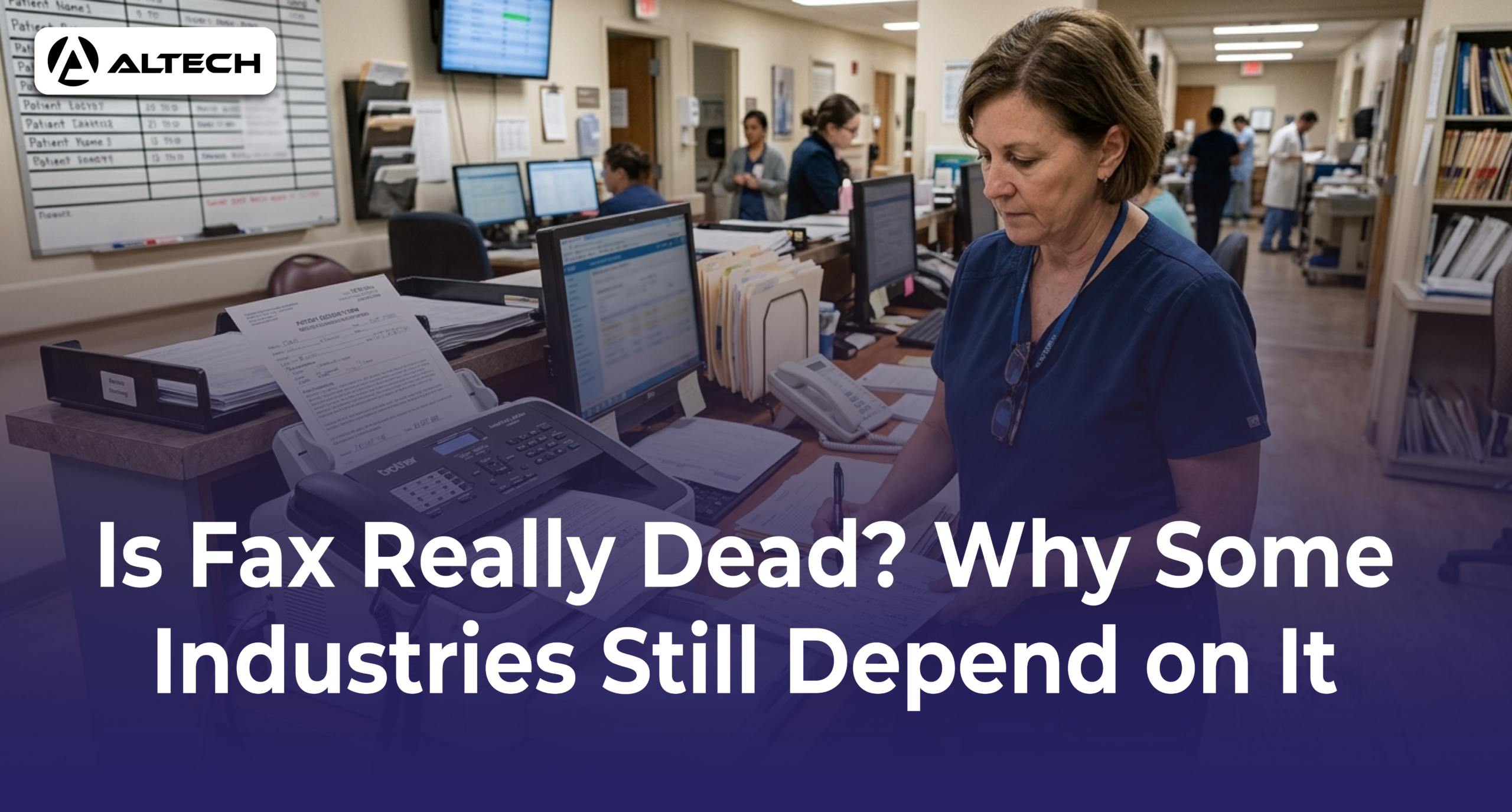
In an age of instant messaging, email, and cloud storage, the fax machine might seem like a relic from the past. It isn’t. Plenty of industries still rely on fax for secure, legally valid document transmission, and the reasons behind that go deeper than habit.
The Surprising Persistence of Fax
Despite people predicting its death for decades, fax is still deeply built into how global business operates. A 2024 report found that roughly 17% of businesses worldwide still use it for critical communication, with even higher adoption in regulated fields like healthcare, law, and government. The global fax services market was valued at $3.3 billion in 2024 and is projected to reach $4.47 billion by 2030. That’s steady growth, not decline.
Why Fax Endures: Key Advantages
Security and Compliance
The biggest reason fax has survived is security. Email travels across the open internet, where it’s exposed to interception, phishing, and malware. Faxes, by contrast, move over dedicated telephone lines or encrypted digital channels, which makes them a naturally safer way to send sensitive information.
In healthcare, for example, over 70% of hospitals and clinics still use fax to share patient records, largely because it helps them meet strict data protection rules. Fax doesn’t carry viruses or malware, and modern digital fax services add:
- End-to-end encryption
- Audit trails (a record of exactly who sent and received what, and when)
- Delivery confirmations
All of which regulators typically require.
Legal Validity and Proof of Delivery
Fax gives you actual proof that a document was sent and received. Every transmission produces a confirmation page with the date, time, and recipient’s fax number, and that receipt holds up as legally admissible evidence in a dispute. Email can’t always say the same.
In legal and financial work, where signed contracts and court documents need to arrive with certainty, fax is still hard to replace. A physical signature on the page combined with a verifiable delivery record gives faxed documents a level of proof that digital signatures and email often can’t match.
Reliability Across Infrastructure
Fax doesn’t need an internet connection to work. It runs over regular phone lines, which means it still works in places with poor or no internet, and it keeps working when email servers crash or networks go down. That kind of independence from digital infrastructure is exactly why some industries won’t drop it.
For businesses working internationally, fax is still a trusted channel, especially with partners in countries like Japan and Germany, where a large share of companies still use it regularly. Having fax capability when dealing with those partners avoids delays and keeps things compatible with the systems they already use.
Cost Efficiency in the Digital Age
Modern fax has dropped the need for a physical machine, paper, or toner. Cloud-based fax services let people send and receive faxes through email or a mobile app, for a fraction of what it used to cost to run the old hardware. Providers charge per page or offer flat monthly plans, which keeps it affordable even for small businesses.
Compared to a courier or registered mail, fax still delivers a document instantly and at a lower cost. Skipping the physical handling of documents saves time too, which adds up to real operational savings.
Industries That Still Depend on Fax
Healthcare
Healthcare is probably the strongest holdout. Medical records, prescriptions, and referral forms carry sensitive patient information that has to be protected under HIPAA and similar privacy laws, and fax gives hospitals, clinics, pharmacies, and insurers a secure, compliant, and traceable way to send it.
- Many electronic health record systems still build in fax as a standard feature
- Pharmacies routinely receive 20 to 30 prescription faxes a day
The mix of security, legal acceptance, and simplicity keeps fax as a core part of how healthcare communicates.
Legal Services
Law firms and courts use fax for time-sensitive documents, contracts, court filings, evidence, because a signed, timestamped page with delivery confirmation proves a document arrived by a specific deadline.
Even firms that have moved mostly digital tend to keep fax capability around, since clients, courts, and opposing counsel often still expect it.
Government and Public Sector
Government agencies deal with official paperwork that often needs a secure, verifiable way to be sent. Fax gets used for applications, permits, and official forms, especially where digital signatures aren’t accepted or audit trails are required by law.
Some government departments have tried phasing fax out and run into pushback from employees and citizens who still depend on it, which says a lot about how embedded it is in public administration.
Finance and Banking
Banks and financial firms send sensitive client data, loan documents, and transaction records every day. Rules like the Sarbanes-Oxley Act require secure handling and audit trails, and fax checks both boxes, letting institutions confirm confidential information reaches the right recipient without being intercepted or altered along the way.
Modern Fax: Not the Old Machine You Remember
Forget the bulky machine with the phone cord and thermal paper. Today’s fax is a digital service that plugs into email, cloud storage, and business software. People send faxes straight from a computer or phone, attach documents as PDFs, and get incoming faxes delivered as email attachments.
These newer tools also offer automatic document sorting, optical character recognition (OCR, which makes scanned documents searchable), and integration with customer relationship management (CRM) software. Some can even use AI to sort incoming faxes automatically, cutting down on manual work.
Global Perspectives on Fax Usage
How much a country uses fax varies a lot. It’s fallen off in some places but stayed strong in others. In Japan, fax machines are still common in both government and private business, and plenty of companies consider them essential for anything formal. In Germany, 82% of companies with 20 or more employees still use fax, and a third of them use it often.
For businesses trading internationally, keeping fax capability around means smoother communication with partners who prefer or require it. Ignoring that can mean missed deals and unnecessary delays.
Addressing Common Misconceptions
“Fax is slow, unreliable, or insecure.” That reputation comes from old hardware and analog systems. Modern digital fax services transmit fast, render documents clearly, and offer security features well beyond what the old machines could do.
“Fax is only for large companies.” Not true. Online fax services are accessible and affordable for small businesses and solo professionals too. With no dedicated phone line or hardware needed, even a one-person practice can use secure, compliant fax.
The Future of Fax
Fax isn’t disappearing, it’s adapting. It’s turning into a hybrid technology that mixes the reliability of an analog signal with the convenience of digital workflows. As long as industries need document exchange that’s secure, legally valid, and traceable, fax will keep its place.
Newer developments like 5G networks and stronger encryption are pushing fax capability further, with faster transmission and better global reach. Add in automation and AI tools, and fax stays relevant even as everything else around it changes.
Final Thoughts
Fax isn’t dead. It’s evolved to fit a digital-first world while holding onto what made it useful in the first place: security, reliability, and legal standing. In industries where those things aren’t optional, fax remains essential.
A business that writes fax off as obsolete may find itself at a disadvantage when dealing with regulated industries, international partners, or clients who still depend on it. Understanding why fax has stuck around, and how much better modern solutions have made it, helps a business make smarter calls about how it communicates.
In a world chasing the newest technology, sometimes the old approach still holds up. Fax is proof that practicality and compliance can outweigh novelty.
For a free consultation contact us at https://wa.me/971569981942 or call us at +971 56 998 1942

